The rescue of Lorenzo and Margarita
By Migue · Colombia, Cali · Yellow-crowned amazon (Amazona ochrocephala)
This story is chapter IX of The Spirit of the Parrots.
For as long as I can remember, I had always wanted a parrot as a companion. I asked around in several places that sold birds across different cities, until in 2024, in the municipality of Circasia, the chance came. A neighbor had Lorenzo and Margarita in her yard — two yellow-crowned parrots whose whistles and calls reached my house every morning. One morning, on my way to work, I stopped at her window and asked about them. We talked for a few minutes; I told her how much I wanted to bring a parrot home, and she said she would let me know if she heard of anyone who could help.
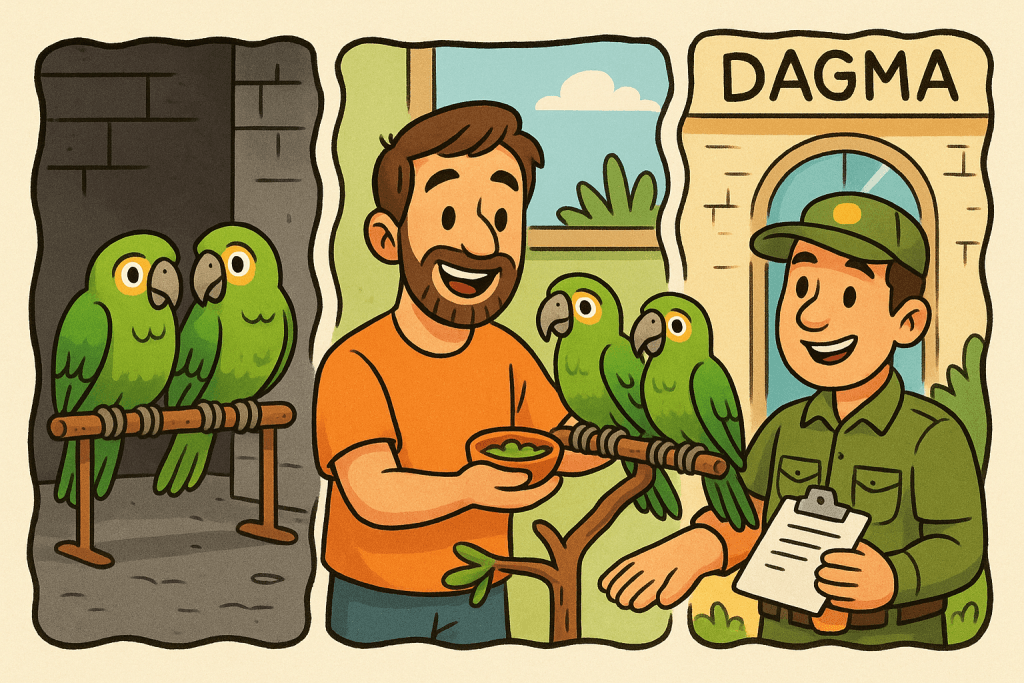
Weeks passed until, on February 2, 2024, she called: she wanted to sell one of the parrots. She invited me into her dark, cold yard, where Lorenzo and Margarita lived on a metal perch barely 30 cm long, above a cage that felt more like a prison than a shelter. The owner, unaware of their needs, clipped their feathers and fed them a diet of sugar-cane water and bread. They lived in fear, distrust, and the aggression that only pain and neglect can produce.
Something in their eyes spoke to me of hope.
She asked $500,000 COP for Margarita. With my husband's help, we put the money together and rescued her, though Lorenzo stayed behind — a cherished gift to one of her children. On May 17, 2024, she called again: she was selling Lorenzo for $550,000 COP. Again, with my husband's determination, we paid part of the amount and took him home that same day, with the rest due eight days later.
At first, it wasn't easy. Every attempt to get close was met with fear, nervous bites, and desperate wing-flapping — but I didn't give up. Day after day, with patience, love, and respect, I earned their trust: my hands didn't want to hurt them, but to heal them, care for them, and protect them. At home I removed cages and metal perches; I put up branches and logs at different heights so they could fly and rest without hurting themselves.
At first, it wasn't easy. Every attempt to get close was met with fear, nervous bites, and desperate wing-flapping — but I didn't give up. Day after day, with patience, love, and respect, I earned their trust. I showed them that my hands didn't want to hurt them, but to heal them, care for them, and protect them. I gave them space, good food and vitamins, gentle words full of love, and time. There were no more cages or metal perches in the house that could hurt their feet. All through the house they had perches of different sizes and heights that let them move freely through the open space I had set aside for them. Margarita was unsteady, and several days passed before she began moving between perches — she would spend hours and hours in the same spot, a consequence of the captivity she had been condemned to for so long. She was unstable, had little balance, and didn't know how to fly. Lorenzo tried to fly but his feathers had been clipped so severely that he couldn't manage it. He was very fearful, startling at any loud noise or sudden movement. But little by little, both of them began to trust. Margarita was the first to perch on my shoulder — timid at first, then Lorenzo the same way, both of them shy but starved for affection. Within a few weeks they were calling me papá, and it became easier to interact with them. They liked being stroked on the head. I had real conversations with Lorenzo, who talked the most, and soon they didn't want to leave my side. They recovered their trust and their joy, and I learned what it means to heal, to care, to love, and to be loved in return.
From the first moment I saw them, I felt that our souls already knew each other. Lorenzo and Margarita, my two yellow-crowned parrots, were not simply birds — they were my babies, my children, my life companions, and the winged teachers life had given me. Our bond ran so deep that, before long, without ever hearing anyone or being taught, they were calling me papá, papito, papi — calling me by name with their sweet, cheerful voices, filling our home with love. They would look for me all through the house on those determined little feet: if they didn't find me in the kitchen, they'd go to the bedroom; if not there, to the living room. Pa', come here. There was no greater joy for us. They loved sitting on my shoulder as I walked through the house, or being with me in bed while we watched television. Lorenzo also liked being held up to the window or the front door to greet the people passing by, or to watch the dogs he adored. "Hello, how are you," he would say in a sweet voice to the people who passed and greeted us. In those moments we shared with them, life became something else entirely. Lorenzo and Margarita filled the silences with funny phrases and flowing, coherent conversations. Each had her own personality — Lorenzo was calm, more inclined to talk than to move; Margarita was a tireless explorer, always curious, always wanting to discover every corner of the house. Each with her own personality, they shared the same essence: pure love. They loved me without conditions, the way only pure beings know how to love. And I loved them with everything I had.
One afternoon, as I watched them from the living room, a current of air brushed the back of my neck though no window was open, and for a second — just one second — I felt in my own chest a longing to fly that was not mine. When it passed, they were both looking at me.
Over time I understood that even without wire cages, captivity doesn't always have visible bars — sometimes it disguises itself as affection, as protection, as habit, as love. But their eyes told me something different: that real freedom wasn't staying with me, but finding their way back to their own kind, to the tall trees, to the open sky. And I understood that I had to give back the freedom we had taken from them.
I contacted several foundations, including Fundación Loros, and finally, on December 13, I coordinated with the Dagma de Cali the voluntary surrender of Lorenzo and Margarita. That day I cried. Not from losing them, but from understanding that loving them also meant letting them go. Lorenzo and Margarita today fly alongside other parrots, going through rehabilitation and learning to be birds again. Every email I receive from their halfway home confirms that they are eating well and that their flight has improved noticeably.
The greatest lesson Lorenzo and Margarita left me was the lesson of loving without possessing. These two parrots who came into my life with sweetness in their eyes and joy in their songs and words taught me that real love is not born from possession, but from respect. Respecting their freedom meant understanding that they were not mine — that they belonged to the trees, to the open skies, and to a wild nature that no cage or concrete walls, however comfortable, could replace.
Sharing that time with them also meant learning to love their species, to understand the vital role parrots play in the ecosystem as seed dispersers and guardians of native species. They are not only beautiful — they are necessary in nature. Having them taught me that domesticating a wild animal, however harmless it may seem and however much love it gives you, is a form of selfishness. However tame they were with me, their place was not within concrete walls but outside, where their instinct calls them. Lorenzo and Margarita were not just birds in my life — they were two teachers who showed me that loving also means letting go, and that preserving wildlife is a deep form of love that goes far beyond thinking only of ourselves.
Analysis and reflections from Fundación Loros
The story of Miguel Ángel and his two yellow-crowned parrots, Lorenzo and Margarita, holds a deep lesson about what it really means to love — to love without possessing. His path, from an improvised rescue to a conscious handover to the authorities, reflects a commitment that goes beyond affection: it means responsibility, humility, and respect for the natural cycle of life.
Rescuing with an open heart
Miguel Ángel acted with generosity: he saw the pain in those abused birds' eyes, pooled resources with his husband, and got them out of an environment that barely covered their basic needs. But his gesture wasn't just instinct; he quickly understood that "saving" isn't enough if you don't ensure their full well-being — proper nutrition, space to fly, environmental enrichment, and above all, time and patience to rebuild trust.
Rehabilitating with patience and love
Rehabilitation doesn't happen overnight. Every uncertain wingbeat, every fear-driven bite, every feather Margarita pulled out were signs of deep trauma. Miguel Ángel kept showing them that his hands were no longer a threat, but a refuge. Day after day, with steady care and small routines, the parrots learned to perch, to trust, to find joy again. In that process, the rescue became an act of mutual healing: Miguel Ángel discovered the restorative power of loving presence.
Letting go as the highest act of love
Perhaps the bravest thing was understanding that Lorenzo and Margarita's real home was far from a balcony or a room lit by screens. By contacting DAGMA and coordinating their handover, Miguel Ángel chose freedom over personal attachment. "Loving them also meant letting them go" became a guiding truth: by giving up his desire to keep them, he gave them back their wings.
An example worth following
This story invites us to rethink the keeping of wild animals: they are not trophies, entertainment objects, or gifts a child can take on without consequences. Miguel Ángel showed an ethical path:
Informed rescue — identify real needs and act with urgency.
Full rehabilitation — adapt the habitat, diet, and daily care routines.
Responsible handover — trust environmental authorities and specialized sanctuaries.
A final thought
In a world where wildlife is often seen as "exotic" or "entertainment", this story reminds us that compassion must be paired with knowledge and respect. Loving a parrot doesn't mean making it a prisoner of our affection — it means recognizing that its true greatness lies in flight, in free song, and in the essential role it plays in the balance of ecosystems.