
The empty cage
By Anonymous · Argentina, Córdoba · Budgerigar (Melopsittacus undulatus)
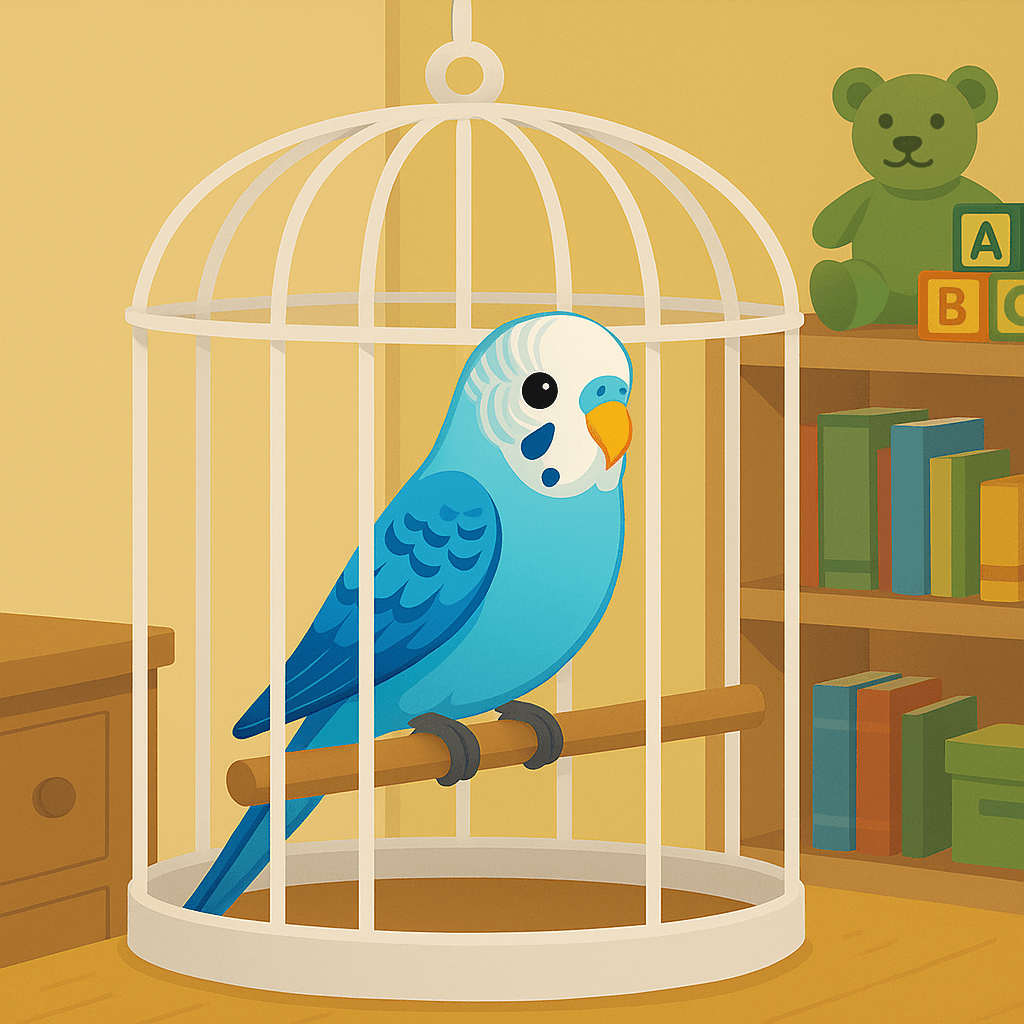
When I was a boy, my mother gave me a small parakeet. At home we called her "la catita." Her feathers were soft, in shades of blue, and she fit entirely in one hand, like a secret. She lived in a small white cage in my room, where her tiny eyes greeted me every morning.
That morning I left for school the way I always did, with no idea that something was about to break forever. When I came back, I found my little sister and my cousin — both around five and a half years old — running toward me with something in their hands, as if they had discovered a treasure. Then, breathless and excited, they told me:
"La catita isn't moving."
They were holding her clumsily; her small body was still warm. At their feet, on the floor, I saw a large bronze anchor-shaped keychain. I never knew why they had it. I didn't want to ask.
I stood still. I didn't cry. I didn't speak. I just looked at her, with the hollow hope that my gaze could give back something of what she had lost.
When I asked what had happened, they told me in trembling voices that they had thrown her into the air several times, trying to watch her fly. But the feathers on her wings had been clipped. She couldn't. And on one of those throws, she hit the wall. And she died.
The little cage sat empty — a small white coffin in my room.
And I understood, without tears, that sometimes the smallest secrets hold the deepest pain.
Analysis and reflections from Fundación Loros
Catita's story shows, with painful clarity, how animals can be treated as simple toys. Two girls play with her still-warm body, aware she is dead, without understanding the value of her life. There is no intentional cruelty — but there is a learned disconnection: seeing the bird as an object, not a living being. This story doesn't look for heroes or happy endings. It only leaves an empty cage and an open question. It reminds us that respect for animals doesn't begin with grand gestures, but with recognizing their existence as worthy, unrepeatable, and never — never — replaceable by a moment of fun.