Lorenzo and the gap between care and the law
By Dita · Colombia, Barranquilla · Yellow-crowned amazon (Amazona ochrocephala)
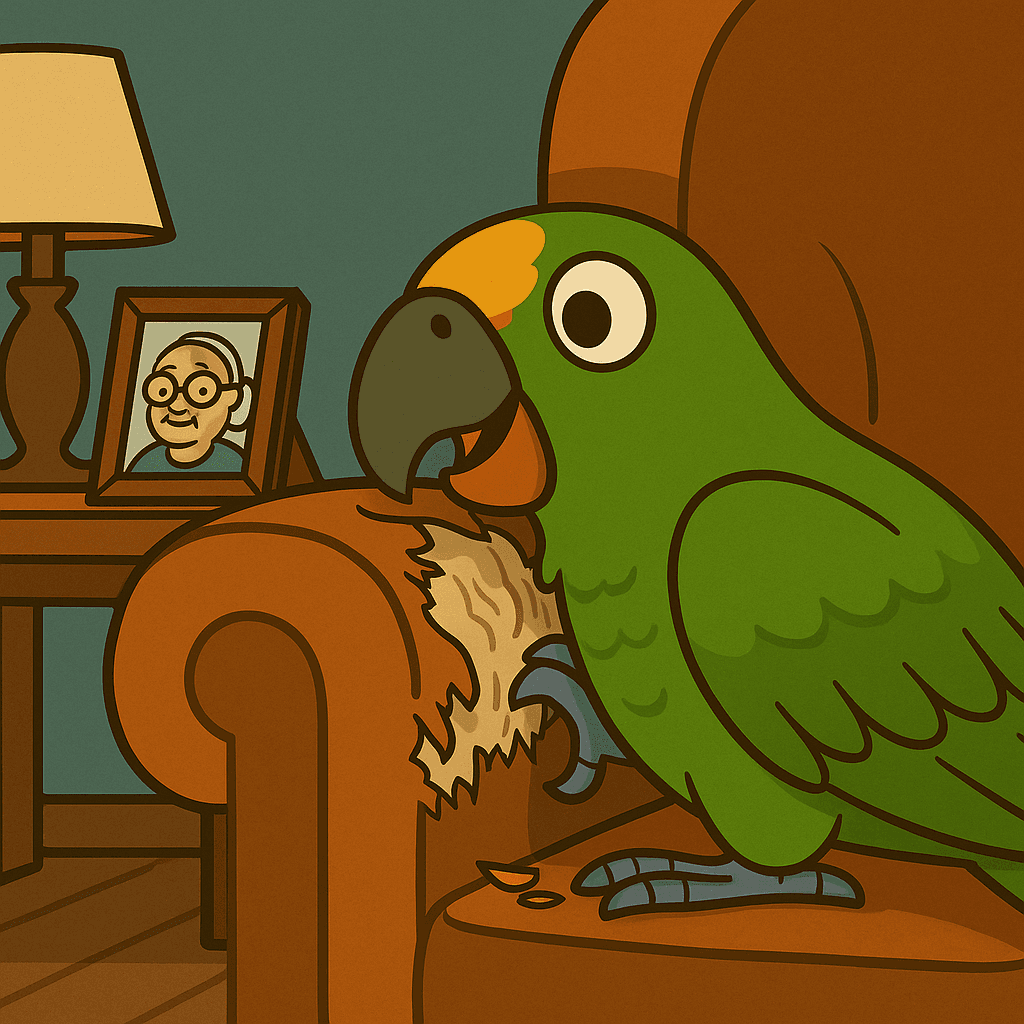
I met him one January, when he was brought into the house in a tiny, horrible cage — not fit for his size — and greeted us with such a happy "Buenas", a word he had surely learned from his previous owner.
I was in shock. I never thought I would see an Amazona ochrocephala — a yellow-crowned parrot — up close like that. I didn't even know what had moved my mother to bring him home, since she had never been a pet person.
It was connection at first sight. I was told his name was Lorenzo, that he was already an adult, and that I should be careful because he bit. But stubbornness and curiosity pushed me to invite him out of the cage, to stretch and explore his new space. And so he did: he came out and stayed up on top of it, and as I stood nearby he lowered his head and fluffed up his feathers, asking me to scratch him.
I thought it might be a trick — lure me in, then bite. But when I dared to touch him, all he did was enjoy a good scratch. In that moment I felt his thirst for affection and attention.
His arrival alone turned my house, my routine, my wallet, and my world upside down. I started researching how to adapt to his needs, and counting every peso in my bank account to slowly buy everything he needed — his own space, enrichment, good health, and food.
His vet told me he was the most gentle parrot he had ever known. Every day with him was a new experience. He gave me a thousand grey hairs — and millions of moments of joy.
I went completely off the rails. I took him on trips, threw him birthday parties, bought him Christmas presents, among other wild things. He wouldn't let me go to the bathroom alone or eat in peace. I learned what it truly means to lose all privacy when you live with a bird.
Over time he wasn't my parrot, and he was never my pet. He was my precious son, the darling of the house. I loved every minute I spent with him.
I always kept in mind that a life in captivity, at home, was not the right one — so whenever anyone asked, I strongly discouraged having a bird. People don't understand what it takes to care for one, or what it means to deprive one of its freedom.
I never chose to send him to a bird facility, because I understood that a hand-raised bird — one raised by people from birth — bonds with and grows used to human presence. These birds don't always get along with other birds, which can cause them real emotional harm. My mission as his guardian was to give him the best possible environment, nutrition, and health for as long as he was with me. Only the best.
Sadly, my boy left this world in 2024, with no explanation. I don't know whether it was natural causes, or whether his earlier life caught up with him in ways we couldn't detect — or that I missed.
I thank God for the chance to meet him, to change his life, and to have mine changed. And if there was something more I could have given him, I hope we find each other again in another life.
I truly hope that, in time, the law can find a way to stop the illegal trade and ownership of these species — because I firmly believe that people don't grasp what it means to keep a bird, or the damage done to ecosystems when animals are taken out of them.
He is, and always will be, the most wonderful life experience I could have had. Others may tell you the same about their parrots, but today, telling you the story of my Lorenzo, I celebrate his life — and I ask that God's infinite love gives him the freedom he always deserved.
Thank you for the space, and don't give up on your work saving every bird that needs it.
Analysis and reflections from Fundación Loros
Lorenzo's story reflects not only the deep bond that can form between a person and a bird, but also the ethical complexity of sharing your life with a wild animal outside its natural habitat.
At Fundación Loros we recognize that many people keep parrots not out of whim, but out of affection, compassion, and a genuine desire to protect. This story is not one of "irresponsible ownership" — it is about someone who devoted their life to repairing a prior harm, with awareness and love. In fact, they speak out against captivity and dream of a world without illegal trade.
But the story also exposes something we cannot ignore: institutional distrust. Many people who rescue birds from situations of abuse are afraid to go to the authorities, for fear of being judged, or of the animals ending up in worse conditions. That lack of trust stems, in part, from a system that still cannot tell apart those who cause harm from those who try to care with what they have.
That is why we issue an urgent call:
To environmental authorities: review how those who have acted in good faith — even outside the law — are treated. More empathy, more listening, and more clarity are needed.
To the institutions responsible for wildlife management: strengthen your transparency and guarantee the real wellbeing of seized animals.
And to society: understand that loving a parrot does not mean owning one. It means respecting its right to fly free.
To those who, like the author of this story, have cared from a place of love — thank you. You are also part of the change. Because no heart that loves should be treated as an enemy. And because the freedom of animals demands institutions that are as compassionate as they are firm.