Protected wildlife of Los Loros Reserve
Tropical dry forest · Villanueva, Bolívar
The territory
Who lives in the reserve
Across the 500 hectares of Los Loros — Regenerative Territory live parrots, primates, mammals, reptiles, and birds under the permanent care of the Foundation, the Colombian Navy, the local farmers, and the volunteers and tourists who look after the reserve.
The tropical dry forest is one of the most threatened ecosystems in Colombia — only fragments remain of what once covered the entire Caribbean coast. What follows is a first editorial inventory of the fauna that still finds refuge here.
These parrots share the reserve with other individuals rescued from the illegal trade, whom the Foundation rehabilitates for their return to the forest.
Also present in the reserve: Bradypus variegatus (three-toed sloth) · Leopardus pardalis (ocelot) · Mazama americana (red brocket deer) · Pecari tajacu (collared peccary) · Dasyprocta fuliginosa (black agouti) · Cuniculus paca (lowland paca) · armadillos (family Dasypodidae) · Procyon cancrivorus (crab-eating raccoon) · Eira barbara (tayra) · Galictis vittata (greater grison).
Also present in the reserve: Green iguana (Iguana iguana) — a large arboreal reptile up to 1.5 m, herbivorous and a natural seed disperser; descends to the ground to nest in sand.
More than 200 bird species have been recorded at Los Loros; the full list can be consulted in the reserve's eBird hotspot. The birdwatchers who visit each season are also part of the eyes that monitor the forest.
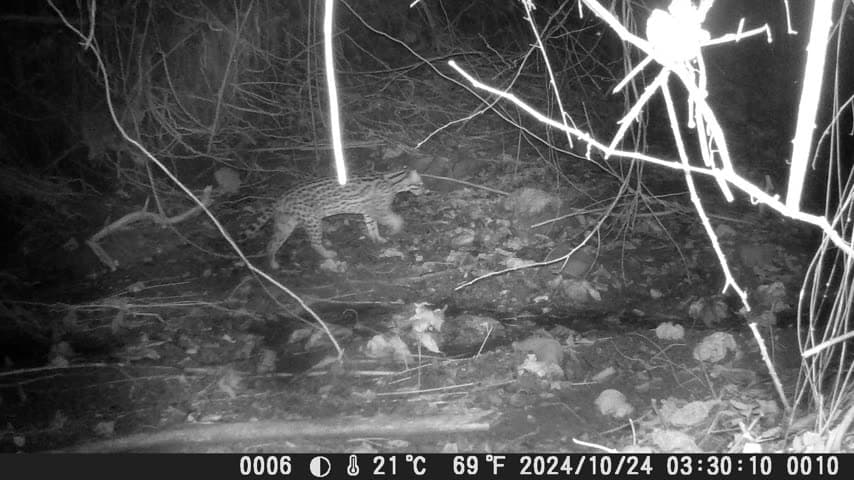
Would you like to see how we monitor the wildlife we protect?
We distribute camera traps across the territory to record what happens when no one is watching. Every appearance confirms who lives here and guides us on where to reinforce protection. More than twelve species recorded so far — from ocelots to tamanduas, including the crab-eating fox, the collared peccary and the white-headed capuchin.
Why it matters
A single web
Each species you see here depends on a connected forest: macaws need tall trees and hollows for nesting; toucans and howlers disperse the large seeds that sustain the canopy; the red-footed tortoise opens paths through the soil. When one disappears, the rest weaken. That is why we protect the 500 hectares as a system — not as a collection of species.
Descriptions adapted from Bosque Seco Tropical: Guía de Especies (UNDP · Humboldt Institute · Ministry of Environment, 2018) and field observations in the reserve.
Environmental oversight and compliance

Supervising environmental authority
Every wildlife release, transfer, and management action in Los Loros Reserve is carried out under the supervision and authorization of the Regional Autonomous Corporation of the Canal del Dique (CARDIQUE), the competent environmental authority for northern and central Bolívar. The Foundation is registered in the Wildlife Friends Network through Resolution No. 1972 of December 28, 2022 and its subsequent acts.
Handling, transfer, and release protocols adhere to the environmental authority's guidelines. Periodic controls and ongoing feedback underpin the continuous improvement of field work and compliance with current regulations.
The logo identifies the environmental authority that exercises oversight; its use does not imply sponsorship or partnership.
Support the tropical dry forest
Every hectare under care protects the species that live within it.
Visítanos · residentes en Colombia
Ven a conocerlos en persona
Estas son las aves que rescatamos, rehabilitamos y devolvimos a la libertad. Puedes venir a pasar una mañana con ellas: dos planes, en español, para quienes viven en Colombia.