We plant the tropical dry forest back
Home to parrots, macaws, and monkeys. In the north of Bolívar, we restore one of Colombia's most threatened ecosystems through a zoning model that puts wildlife first.
One of the most threatened ecosystems on the planet
The tropical dry forest supports a unique biodiversity — psittacines, primates, felines, migratory birds — and yet it is one of the most overlooked ecosystems in conservation. Globally, less than 5% remains of its original cover. In Colombia, of roughly 9 million hectares, only around 720,000 ha survive — between 8% and 9% of the original area.
And what little survives is not always mature forest: a significant portion is scrubland and secondary forest, fragmented and isolated. That is why every hectare we restore counts twice — it recovers surface area and reconnects the landscape.
This line of work aligns with the Fundación Loros Manifesto and with the Management Model: the rehabilitation of psittacines is only viable if the territory they return to offers forest with food, cavities, tall trees, and low human pressure. Forest restoration is the necessary condition for the reintroduction program.
Sources: Pizano & García (eds.), El Bosque Seco Tropical en Colombia, Instituto Alexander von Humboldt, 2014; Ministerio de Ambiente y Desarrollo Sostenible.
Our work in Villanueva, Bolívar
Northern Bolívar holds one of the most significant remaining areas of tropical dry forest in Colombia. This is where we focus our work: three active compensation and conservation agreements, planting native species and restoring surface cover, connectivity, and carrying capacity for the wildlife that still survives here.
The agreements involve three environmental authorities (ANLA, CARDIQUE and CRA) and together commit 21,888 tropical dry forest trees to planting, more than 33 hectares under active restoration, and corridor strips along streams. Out of confidentiality for our counterparts, we present these cases without naming the companies involved; you can find the technical detail in each authority's public reports.
Ecological corridors: streams are the veins of the forest
Every stream on the property is preserved as an ecological corridor, with a protected strip of 30 meters on each side. That strip — the riparian buffer — is kept free of productive activity and enriched with native species, ensuring water, shade, and connectivity so wildlife can move between the core and the edges.
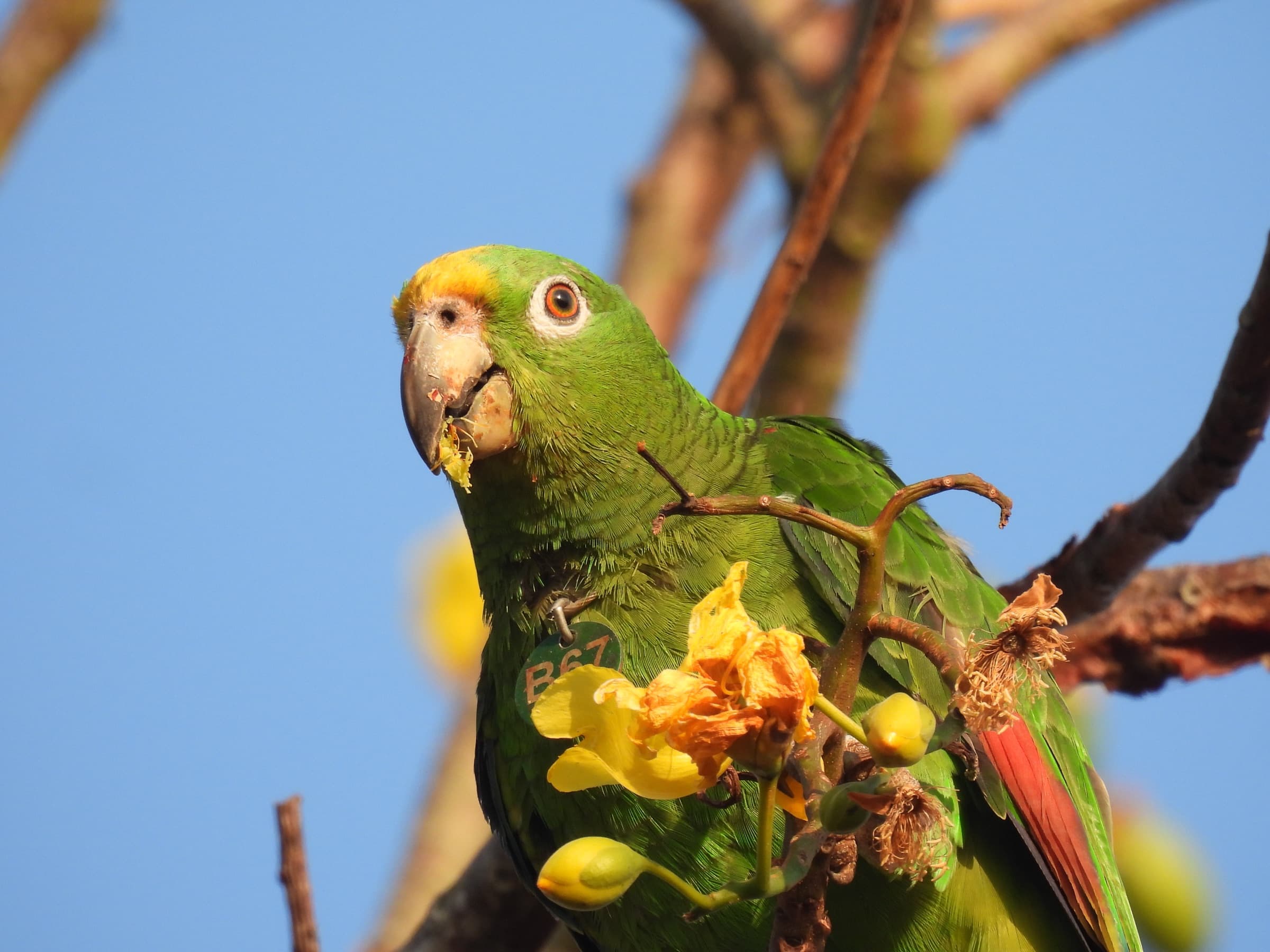
We plant with psittacines and primates in mind
We design our species palette to offer two things: shelter (refuge and nesting) and food (fruit, seeds, and flowers) year-round. We work with a catalog of more than 100 tropical dry forest species prioritized by their value to wildlife and their regional availability — ceiba bonga, jabillo, camajón, orejero, palma de vino, caracolí, jobo, guásimo, matarratón, macondo, caoba, roble, among others.
The full breakdown is on our blog, where we explain what each agreement plants and why each species benefits the wildlife that uses the land.
ICA-certified Nursery
The Vivero Fundación Loros is registered with the Instituto Colombiano Agropecuario as a producer and distributor of plant propagation material, under Resolución ICA N° 00001884 of March 3, 2023, with indefinite validity. This means every tree we plant — in offset projects, volunteer experiences, or tourist experiences — comes from a traceable, technically supervised nursery authorized to produce.
The nursery is authorized for 83 timber species, 14 fruit species, and 88 ornamental species, all relevant to tropical dry forest restoration and Caribbean landscape regeneration.
Learn about the Vivero Fundación Loros — the priority species for tree planting and how we orient the nursery toward parrots and macaws.
At least 35% of the trees are native fruit species
In every offset project we carry out on the property, we make sure that at least 35% of the trees planted are native fruit species of the tropical dry forest. This is how we ensure the offset doesn't stop at timber, but returns real food for wildlife and for Caribbean communities.
In the most recent agreement, this 35% floor was incorporated as a formal clause, not just as good practice. The list includes jobo, ciruela, guayaba agria, mamón, mamey, zapote, caimo, achiote, anón, guanábana, guáimaro, and palms such as corozo, along with fruit species adapted to the tropical dry forest like mango and tamarind — which, while not native, adapt perfectly and are a highly valuable food source.
Environmental oversight and compliance
Fundación Loros conducts its operations under the supervision of the Regional Autonomous Corporation of the Canal del Dique (CARDIQUE), the competent environmental authority for northern and central Bolívar.
Registered in the Wildlife Friends Network · Resolution No. 1972 of December 28, 2022 and its subsequent acts.
The logo identifies the environmental authority that exercises oversight; its use does not imply sponsorship or partnership.
Does your company or organization need to offset?
We receive environmental offsets and voluntary partnerships to expand the hectares under restoration. Each hectare means forest, wildlife returning, and a replicable model for the Colombian Caribbean.